Independent Contractor vs Employee: What DOL's New Rule Means for Hiring
DOL's Nov 19 final rule centers control and profit or loss in independent contractor vs employee. What small employers should check before hiring.
By ReadyATS Team · · 5 min read

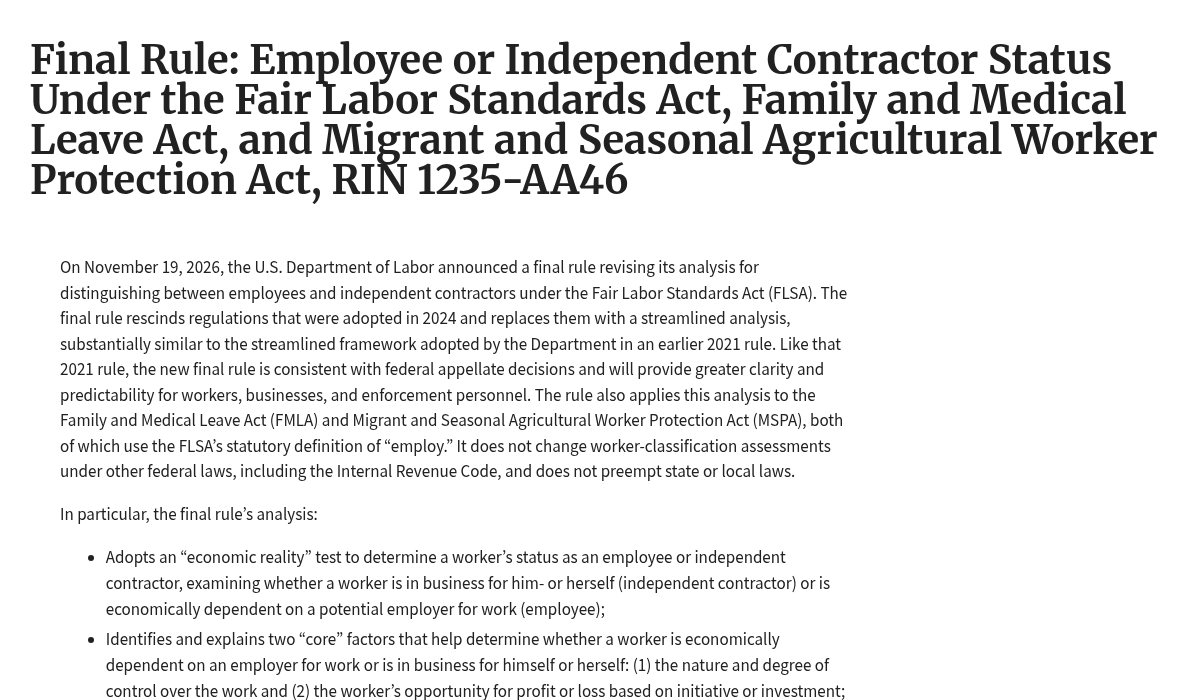
On November 19, 2026, the U.S. Department of Labor announced a final rule that changes how it decides whether a worker is an employee or an independent contractor under the Fair Labor Standards Act. The rule rescinds the 2024 regulations and replaces them with a streamlined analysis that DOL describes as substantially similar to the framework it adopted in 2021 (U.S. Department of Labor, November 19, 2026).
Why now: the rule takes effect 60 days after it is published in the Federal Register. If you run a restaurant, cleaning crew or home care agency, now is a good moment to look again at who you pay on a 1099 and who you pay on a W-2. This guide covers the independent contractor vs employee question in plain terms and pairs with our playbook on how to hire contract workers.
This article is general information, not legal advice. Talk to an employment attorney about your specific workers.
What the final rule says
According to DOL, the rule:
- Uses an "economic reality" test. A worker who is in business for themselves is an independent contractor. A worker who is economically dependent on a potential employer for work is an employee.
- Names two core factors. The nature and degree of control over the work, and the worker's opportunity for profit or loss based on initiative or investment.
- Keeps three other factors. The amount of skill the work requires, how permanent the working relationship is, and whether the work is part of an integrated unit of production.
- Puts practice ahead of paperwork. What the worker and the business actually do matters more than what a contract says is possible.
- Adds 14 examples. New ones cover farm labor contractors, digital platform workers and truck drivers.
DOL also says the analysis applies under the Family and Medical Leave Act and the Migrant and Seasonal Agricultural Worker Protection Act. It does not change worker classification under other federal laws, including the Internal Revenue Code, and it does not preempt state or local laws.
How the two core factors work
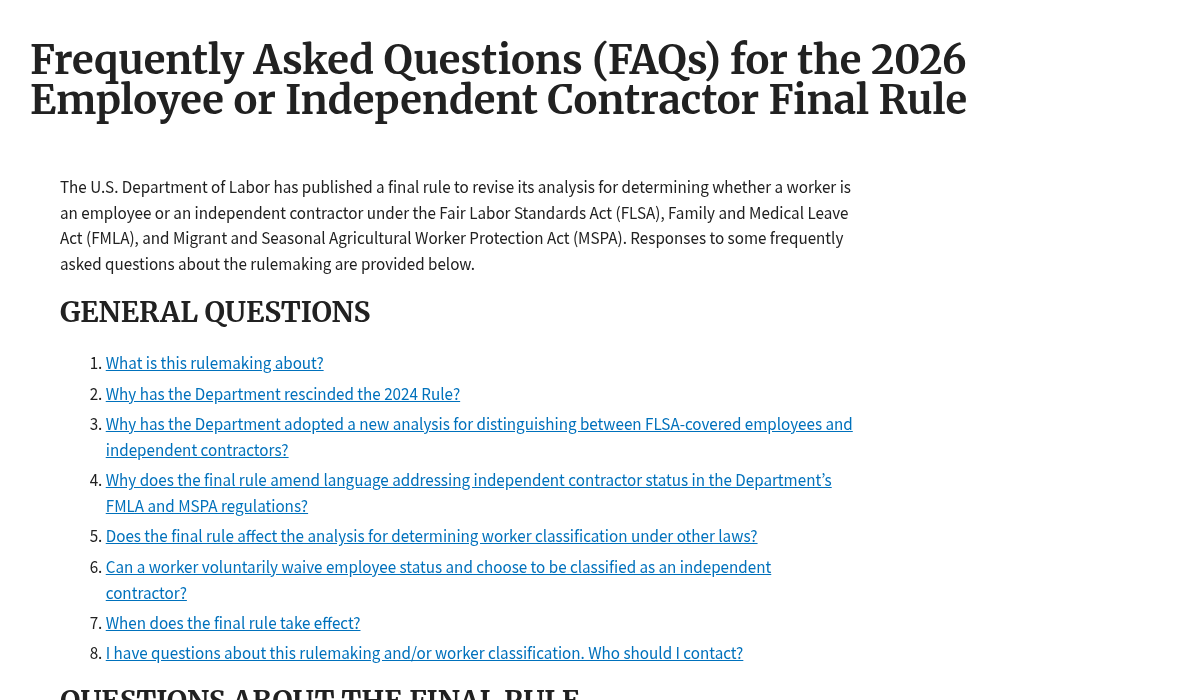
DOL's FAQ explains each core factor in practical terms (DOL FAQs).
Control. This factor leans toward contractor status when the worker has substantial control over key parts of the work, such as the schedule, which projects to take, or the freedom to work for others. It leans toward employee status when the business sets the schedule or workload, or requires the worker to work only for it.
Opportunity for profit or loss. This factor leans toward contractor status when the worker can earn more or lose money through their own initiative or investment, for example by hiring helpers or buying equipment. It leans toward employee status when the only way to earn more is to work more hours or work faster.
If both core factors point the same way, DOL says there is a substantial likelihood that is the correct classification. The FAQ adds two points. A worker who is an employee under the FLSA cannot waive those rights by agreeing to be called a contractor. And the rule itself does not require employers to take any action on or after its effective date.
A five-step check before your next hire
1. List every role you pay outside payroll
Delivery, cleaning, event staff, tutors, drivers. Write down who sets each person's schedule and who supplies the tools.
2. Compare the paperwork with the actual day
DOL says real practice outweighs the contract. If the agreement says "set your own hours" but a manager texts shift times every week, the agreement is not the whole story.
3. Check your state's rules
The federal rule does not preempt state or local law. Your state may use a different test, so confirm with your state labor department or an attorney.
4. Decide role by role, then write it down
Note which factors point which way and what you decided. If a role belongs on payroll, plan the switch before the busy season, not during it.
5. Move fast on W-2 roles
Once a role is a payroll job, a fast, clear hiring process is what wins the applicant.
A hypothetical example
A hypothetical bakery with two locations pays three delivery drivers per route on a 1099. The owner sets their pickup times, assigns the routes and provides the insulated bags. After reviewing the core factors with counsel, she moves the delivery role to part-time W-2, posts it with the hours up front, and makes offers within the same week.
Why ReadyATS
When a role moves onto payroll, the hiring has to be quick and the paperwork has to be complete. ReadyATS covers apply, schedule, offer, e-sign and onboarding in one place:
- Knock-out questions you write, such as "Can you work Saturday mornings?", sort applicants by your own rules. ReadyATS never auto-rejects on an AI score.
- Self-scheduling. When a strong applicant has had no review, Maya sends a self-schedule invite by email and text, and interview reminders include a one-tap reschedule link.
- Live interviews by Google Meet or Zoom, so a first conversation fits around a shift.
- Checkr background checks and Checkr Identity Verification through the same integration.
- Offer and onboarding follow-up. Maya chases an unsigned offer with a fresh signing link and nudges new hires when onboarding documents or tasks stall.
See how it fits a team your size on our ATS for small business page. No long-term commitment, cancel anytime.
The rule decides who counts as an employee. Your process decides how fast they start.
Starting ReadyATS in 15 min Now
FAQ
What is the difference between an independent contractor and an employee?
Under DOL's 2026 final rule, an independent contractor is in business for themselves, while an employee is economically dependent on a potential employer for work. DOL weighs control over the work and the opportunity for profit or loss most heavily.
When does the new independent contractor rule take effect?
DOL says the final rule takes effect 60 days after it is published in the Federal Register.
Does the DOL rule override state law?
No. DOL says the rule does not preempt state or local laws, and it does not change classification under other federal laws, including the Internal Revenue Code.
Can a worker choose to be a contractor instead of an employee?
No. DOL says a worker who is an employee under the FLSA cannot waive FLSA rights such as minimum wage or overtime pay.