Big Employers Want Experience. Small Firms Can Win Early-Career Talent
Since late 2022, jobs for workers 30 or younger in AI-exposed office roles have fallen while jobs for workers 35 and older rose more than 7 percent. Six steps small firms can use to hire early-career talent fast.
By ReadyATS Team · · 5 min read

Large employers are hiring fewer beginners, and that opens a door for small businesses. On November 15, 2026, a Washington Post analysis of Stanford University and ADP payroll data found that since late 2022, employment for Americans 30 or younger has dropped in office jobs considered highly exposed to AI, such as software development, sales and accounting. Over the same period, employment for people 35 and older in those occupations climbed more than 7 percent (The Washington Post, via the Arkansas Democrat-Gazette, November 15, 2026).
Why now: the same report cites the Burning Glass Institute, which found that job postings for tech, business and legal roles have been moving toward candidates with six or more years of experience and away from those with fewer than three. If you run a small accounting practice, a bookkeeping service, an insurance agency or a local sales team, the early-career candidates big firms are passing over are looking right now. This guide covers how to find them, judge them fairly, and hire them before someone else does.
What the data shows
The report pulls together several sources. Here is what matters for a small employer:
- Employment for workers 30 or younger has fallen in AI-exposed office occupations since ChatGPT launched in late 2022, while employment for workers 35 and older in those same jobs rose more than 7 percent.
- Census Bureau data for a group of technology sectors shows employment holding up for workers 35 to 54 from early 2023 to late 2025, while employment for workers under 35 in those industries fell sharply.
- Postings for tech, business and legal roles have shifted toward six or more years of experience, according to the Burning Glass Institute.
- Experts disagree on the cause. Some point to AI, and others say employers are leaning on experienced staff to get more done with smaller teams.
Matt Sigelman, president of the Burning Glass Institute, summed up the large employer mindset: "If you're hiring fewer people, you need people who are operating at peak productivity."
Why this is an opening for small firms
When large employers raise the experience bar, they leave behind capable people with two or three years of work, recent graduates, and career changers. Many of them have the exact skills a small office needs: comfort with software, customer communication, and a willingness to learn your way of doing things.
A small firm also offers what a large employer often cannot. A new hire works next to the owner, sees every part of the business, and takes on real clients sooner. For an early-career candidate, that is a strong reason to say yes. The catch is speed. These candidates are applying widely, and the employer who replies first usually gets the interview.
How to hire early-career talent well
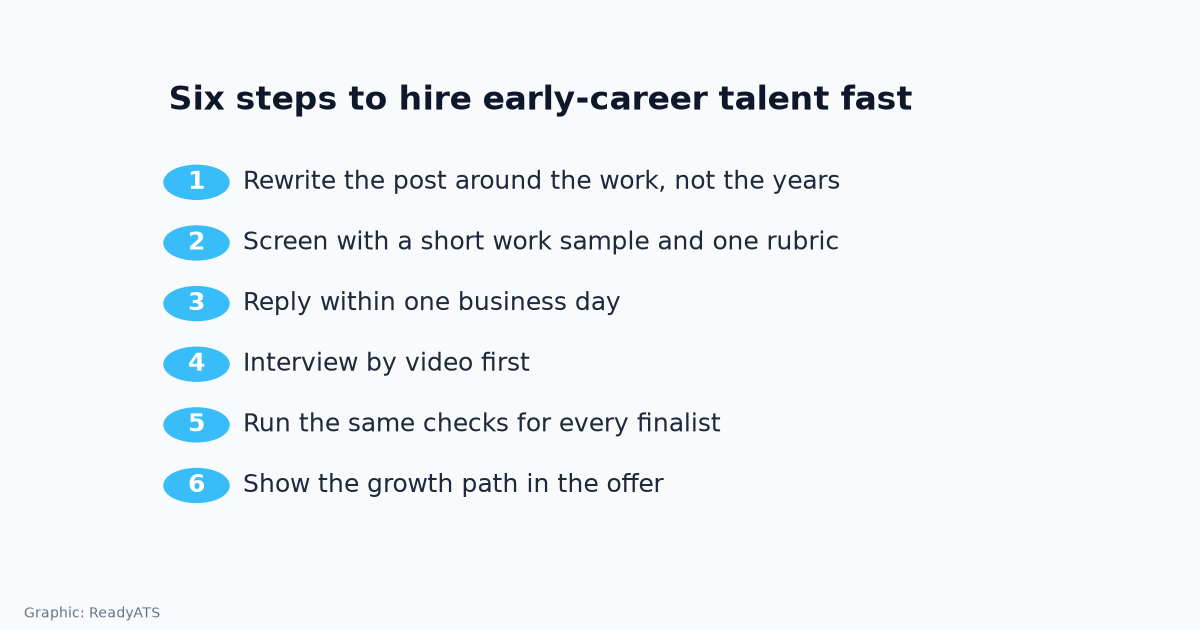
1. Rewrite the job post around the work, not the years
Replace "3 to 5 years required" with the tasks the person will do in the first 90 days. List the tools they will use and the training you provide. Put pay, schedule and location in the first lines.
2. Screen for skills you can see
Ask for a short work sample tied to the job. A bookkeeping candidate can reconcile a sample statement. A sales candidate can write a follow-up email to a hypothetical lead. Score every sample with the same simple rubric.
3. Reply within one business day
Send an acknowledgment and an interview invite quickly. Early-career candidates often have several applications open, and a fast reply signals that your firm is organized.
4. Interview by video first
A 20 minute video call lets you meet more candidates without blocking out half a day. Save the in-person visit for finalists so they can meet the team.
5. Run the same checks for every finalist
Use the same questions, the same scorecard and the same background check for each finalist. Consistency is fairer and keeps your decision easy to explain.
6. Show the growth path in the offer
Spell out what the first year looks like, such as training milestones or client responsibility. A clear path helps an early-career hire choose you and stay.
A hypothetical example
A hypothetical six person bookkeeping firm needs a staff accountant before tax season. Instead of asking for five years of experience, the owner lists the client work, the accounting software, and the weekly training sessions. She asks each applicant to reconcile a one page sample statement, replies to every applicant within a day, and holds 20 minute video interviews that week. Two finalists complete the same background check, and she makes an offer to a career changer with two years of bank operations experience.
Why ReadyATS
Winning early-career talent comes down to moving fast and treating every candidate the same way. ReadyATS gives a small team the tools to do both:
- Live interviews by Google Meet or Zoom, so you can meet candidates by video the same week they apply.
- Checkr background checks built in, so every finalist goes through the same screening step.
- Checkr Identity Verification through the same integration, so you confirm a candidate is who they say they are before you extend an offer.
No long-term commitment, cancel anytime. That makes it easy to start before your busy season and keep going only if it works for you.
The talent big employers skip can anchor your team for years. Be the first firm to call.
Starting ReadyATS in 15 min Now
FAQ
Why are entry-level office jobs harder to land in 2026?
A Washington Post analysis published November 15, 2026 found that employment for workers 30 or younger has dropped since late 2022 in AI-exposed office jobs such as software development, sales and accounting, while employment for workers 35 and older in those jobs rose more than 7 percent.
Should a small business hire early-career candidates?
Many small firms benefit from it. Early-career candidates often bring current software skills and a willingness to learn, and a small firm can offer them hands-on work and a clear growth path that larger employers may not.
How do I screen candidates who have little work history?
Use a short work sample tied to the job, score it with the same rubric for everyone, and follow with a structured video interview using the same questions for each candidate.
How fast should I respond to early-career applicants?
Aim for one business day. Early-career candidates often apply to many openings at once, and the employer who replies first usually gets the interview.