How to Hire Employees for Small Business as Hiring Picks Up
ADP says private employers added 19,750 jobs a week through late October. How to hire employees for small business when more shops are hiring at once.
By ReadyATS Team · · 5 min read

If you run a shop, a clinic, a contractor crew, or a small office, hiring just got a little more competitive. On November 10, 2026, ADP Research reported that U.S. private employers added an average of 19,750 jobs per week in the four weeks ending October 24, and said hiring strengthened for the second week (ADP NER Pulse, November 10, 2026). The figures are preliminary and could change. That is the backdrop for how to hire employees for small business this month: more employers are adding people at the same time, so the applicants you want may already be talking to someone else.
Why now: the latest reading is the second weekly increase in a row, after a dip earlier in October. It is still below the 26,000 average for the four weeks ending September 26. A small team that replies slowly will feel the added competition first.
What the weekly numbers show
ADP's NER Pulse is a seasonally adjusted four-week moving average of the week-over-week change in private employment, published with a two-week lag. In the 12 weeks included in the November 10 release, the average fell to 10,000 for the window ending August 15, climbed to 26,000 for the window ending September 26, dropped to 16,750 for the window ending October 10, then rose to 19,500 and 19,750 in the next two readings. ADP will publish the next update on November 17, 2026.
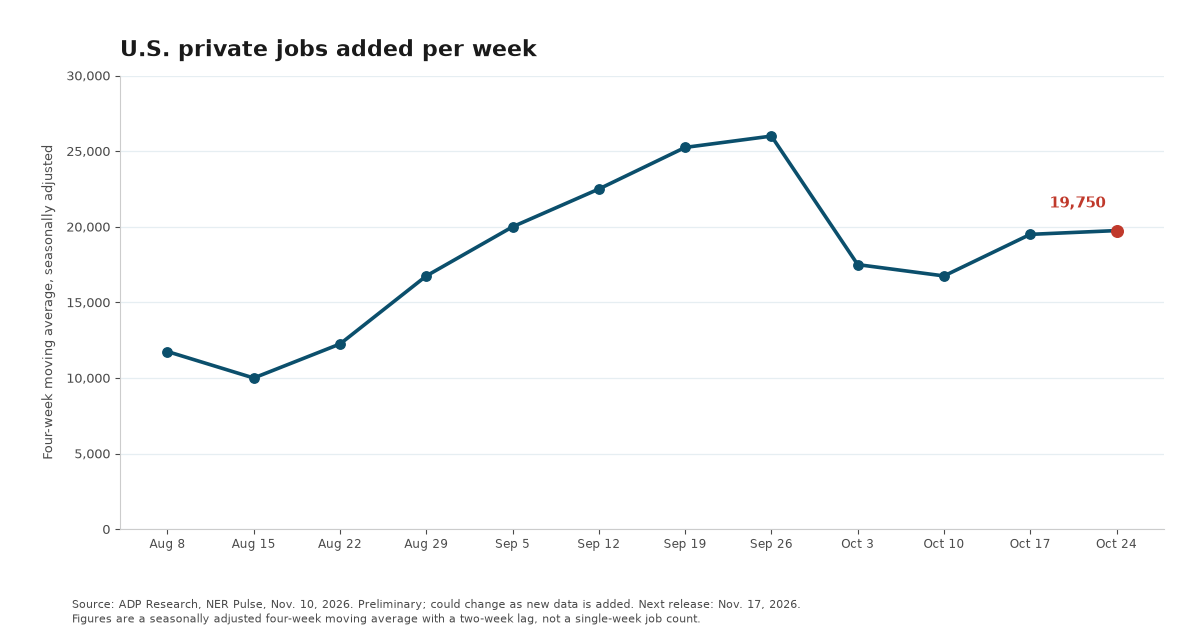
These numbers are not a count of jobs added in a single week, and consecutive readings cover overlapping periods. Use them as a backdrop, then look at your own pipeline: how long openings sit, how fast you reply, and where good applicants drop off.
How to hire employees for small business: a same-week plan
1. Post the job people can say yes to
Put the hourly or salaried pay, the weekly hours, the start date, the location, and the real requirements in the first lines. If you train on the job, say so. If a license or a tool is required, say that too.
2. Make applying short
A candidate on a break will finish a short mobile form and skip a long one. Ask only for what you will actually use this week: contact information, availability, and the experience that matters for the role.
3. Reply the same day
Set a fixed time each day to review new applicants. A same-day call or text beats a careful note that arrives after the person has already accepted another shift elsewhere.
4. Interview quickly, then decide
A 15 minute video call on Google Meet or Zoom can confirm availability, shift preference, and experience. If you want the person to see the floor, the shop, or the kitchen, schedule that visit for the next day, not the next week.
5. Keep one list, not a stack of inboxes
Every applicant should live in one place, with a status you can see. That is how a two-person office avoids losing a good candidate because a resume sat in the wrong inbox.
A faster process vs an ad-hoc one
Comparison table 1: scroll horizontally or focus the table region and use the arrow keys to read every column.
| Factor | Ad-hoc hiring | A same-week process |
|---|---|---|
| Who sees new applicants | Whenever someone checks email | A set review time every day |
| Time to first reply | Often days | Same day |
| Interview | Hard to fit around the floor | A short video call, then a visit |
| Status | Spread across inboxes and notes | One list, one status per person |
| What you learn next week | Hard to say why a role is still open | You can see where people stall |
A hypothetical example: a 22-person HVAC shop needs two technicians. The owner posts the $28 hourly rate (hypothetical), the 7 a.m. start, and the service area in the first lines. She reviews applicants at 8:30 each morning, holds 15 minute video calls that afternoon, and invites two finalists to ride along the next day. Offers go out before the week is over.
National job figures are a backdrop, not a plan. Pair them with your own numbers, as we described when headlines and local results disagree, and use that habit as you work out how to hire employees for small business this quarter.
Why ReadyATS
When more employers are hiring at once, the team that follows up first has the edge. ReadyATS AI hiring software helps small employers do that:
- Live interviews without the commute. Schedule interviews with Google Meet or Zoom links, so a candidate who applies on a break can talk with you the same day.
- A morning briefing that points to people, not vanity totals. Maya, the assistant in ReadyATS, opens with a short page that judges a few KPIs, such as time to hire, against a target you set, and links every number to the people behind it.
- Follow-up that waits for your approval. Maya can propose a templated acknowledgement email and text for an applicant who has not been contacted within 24 hours, and a self-schedule invite by email and text for a strong applicant. You approve each message before it goes out.
No long-term commitment, cancel anytime. Try it on your next opening.
The small businesses that hire this month will be the ones who answer first and keep every applicant in sight.
Starting ReadyATS in 15 min Now
FAQ
How to hire employees for small business when more companies are hiring?
Post pay and hours clearly, make the application short, reply the same day, hold a short video interview quickly, and keep every applicant on one list with a visible status.
What did ADP's November 10 report say?
ADP Research's NER Pulse estimated that U.S. private employers added an average of 19,750 jobs per week in the four weeks ending October 24, 2026, up from 19,500 for the window ending October 17. ADP said hiring strengthened for the second week and that the figures are preliminary.
Is 19,750 jobs a count for a single week?
No. ADP says the NER Pulse is a seasonally adjusted four-week moving average with a two-week lag. Consecutive readings cover overlapping periods, so the number is not a single-week total.
How can a small team keep up without adding a recruiter?
Give hiring a daily time slot, keep applicants in one system, and use tools that surface who is waiting. In ReadyATS, Maya's morning briefing points you to the people behind each number, and follow-up messages go out only after you approve them.