How to Hire Warehouse Workers as Temp Hours Climb
Industrial temp staffing hours rose 18% over the year. How small warehouses and distributors can hire their own crew faster, with a same-week plan.
By ReadyATS Team · · 5 min read

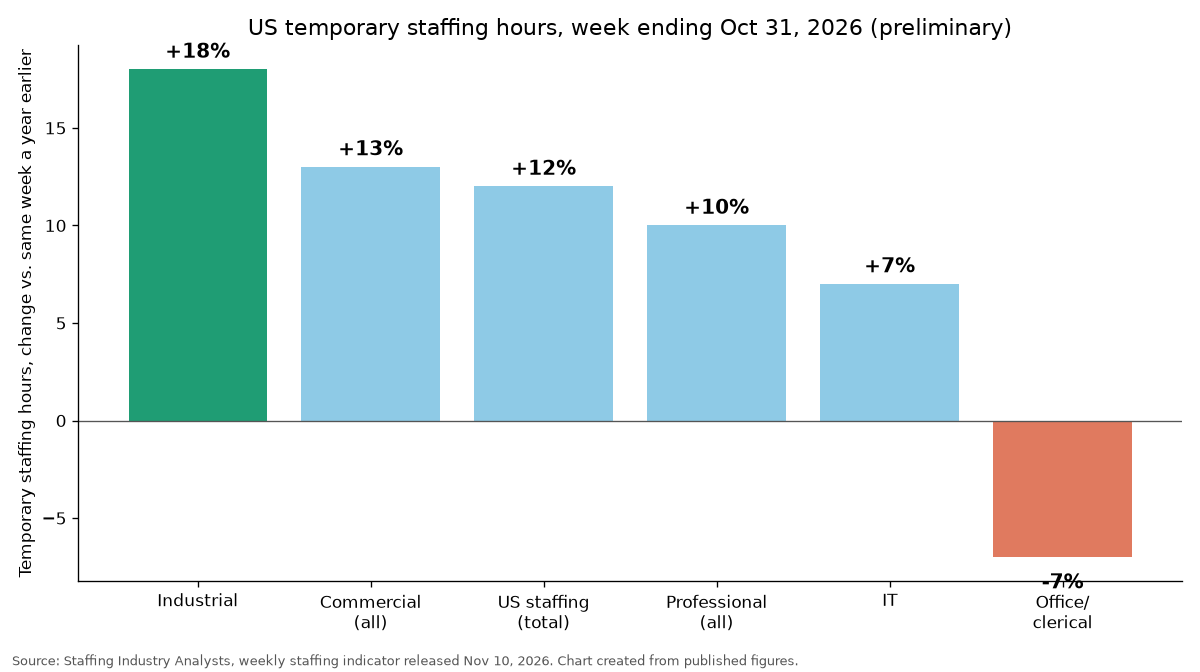
If you run a small warehouse, a distribution business, or a light manufacturing shop, the way you hire warehouse workers this season deserves a fresh look. On November 10, 2026, Staffing Industry Analysts reported that hours worked by U.S. temporary staff were up 12 percent from a year earlier in the week ending October 31, and that industrial staffing hours were up 18 percent (Staffing Industry Analysts, weekly staffing indicator, November 10, 2026). The firm said total temp hours reached another high for the year.
Why now: the firm credited the industrial ramp, which began in late April, to returning demand from manufacturing and logistics clients and from work related to data center construction. When that much demand flows through temp labor, small employers who hire their own crew directly are competing with it for the same forklift operators, pickers, packers, and loaders.
What the numbers say about industrial hiring
The same report broke the week down by job type. Industrial hours were up 18 percent over the year, IT staffing hours were up 7 percent, and office and clerical hours were down 7 percent. Industrial temp workers averaged 36.7 hours that week. The firm notes that readings for the most recent four weeks are preliminary and may be revised.
Pay is the other half of the picture. On the same day, the U.S. Bureau of Labor Statistics reported that real average hourly earnings for production and nonsupervisory employees rose 0.1 percent from September to October after adjusting for inflation. Their real average weekly earnings fell 0.3 percent, because the average workweek also fell 0.3 percent (BLS Real Earnings, October 2026). For an hourly worker, fewer hours can mean a smaller paycheck even when the hourly rate holds. That makes the number of hours you can promise a real selling point.
How to hire warehouse workers: a same-week plan
1. Post the shift, not just the job
Write the title people search for: warehouse associate, order picker, forklift operator, shipping and receiving clerk. Then put the shift in the first line. Start time, end time, which days, and whether overtime is available.
2. Lead with pay and steady hours
State the hourly rate and the weekly hours you expect to offer. If the role is full time and year round, say so plainly. With weekly hours slipping for many hourly workers, a dependable schedule is part of your pay story.
3. List only the real requirements
If a forklift certification is required, say so. If you train on site, say that instead. Spell out physical demands such as lifting limits and standing time so candidates can judge the fit before they apply.
4. Reply the same day and interview fast
Review new applicants at a fixed time each day. A 10 minute video call can confirm availability, shift preference, and experience. Follow it with a short walkthrough of the floor so the candidate sees the work and meets the lead.
5. Run the same screening for every finalist
If your policy calls for a background check for a role, apply it the same way to every finalist and follow your state and local rules on timing. Confirming that the person who shows up is the person you interviewed protects your team and your inventory. That identity step is separate from work authorization and I-9 paperwork, which follow their own legal process.
Direct hire vs leaning on temp labor
Comparison table 1: scroll horizontally or focus the table region and use the arrow keys to read every column.
| Factor | Mostly temp labor | Direct hiring process |
|---|---|---|
| Who knows your floor | Changes week to week | A crew that stays and learns |
| What the posting leads with | Often set by someone else | Your pay, your shifts, your hours |
| Speed to first conversation | Depends on the agency | Same day, set by you |
| Screening | Varies by source | The same steps for every finalist |
| Training investment | Repeats with each new face | Builds on people you keep |
Temp labor has a place, especially for a short peak. The point is to make direct hiring fast enough that it is a real option for roles you need every week.
A hypothetical example: a regional food distributor with 40 employees needs three order pickers for a second shift. The operations manager posts the $19 hourly rate (hypothetical), the 2 p.m. to 10:30 p.m. schedule, and the 40 weekly hours in the first lines. She reviews applicants every morning at 9, holds short video calls that afternoon, and invites two finalists for a floor walk the next day. Offers go out by Friday.
When you are ready to add screening to that flow, our guide to ATS and background check integrations explains how the steps fit together.
Why ReadyATS
Warehouse hiring rewards the employer who moves first. ReadyATS AI hiring software helps small warehouses and distributors do that:
- Live interviews without the commute. Schedule interviews with Google Meet or Zoom links, so a candidate who applies on a break can talk with your lead the same day.
- Checkr background checks in one place. Order background checks through the ReadyATS Checkr integration instead of logging into a separate portal.
- Checkr Identity Verification. Through that same integration, order Checkr IDV, which matches a live selfie to a government ID, so the person on the dock is the person you interviewed.
No long-term commitment, cancel anytime. Try it on your next warehouse opening.
Temp hours are climbing because demand is real. The warehouses that hire their own crew fastest keep the people they train.
Starting ReadyATS in 15 min Now
FAQ
How do I hire warehouse workers quickly?
Post the shift times, hourly pay, and weekly hours in the first lines, list only the real requirements, reply to applicants the same day, hold a short video interview, and finish with a quick floor walkthrough.
How much did temporary staffing hours grow in late October 2026?
Staffing Industry Analysts reported that U.S. temporary staffing hours were up 12 percent from a year earlier in the week ending October 31, 2026, with industrial hours up 18 percent. The firm says recent weeks are preliminary.
Why does the length of the workweek matter to hourly applicants?
BLS reported that in October 2026 real weekly earnings for production and nonsupervisory employees fell 0.3 percent because the average workweek fell 0.3 percent. Steady, clearly stated hours can make your offer stand out.
Should a small warehouse run background checks?
That depends on your policy, the role, and state and local law. If you run them, use the same process for every finalist. ReadyATS lets you order Checkr background checks and Checkr Identity Verification from one place.