Is AI hiring legal? NYC Local Law 144 and the EU AI Act
Is AI hiring legal? A plain-English look at NYC Local Law 144 and the EU AI Act, with official sources. This is not legal advice.
By ReadyATS Team · · 5 min read

Many small HR teams now ask a direct question before they turn on resume scoring: is AI hiring legal? Employers may use software to help review applicants, but some rules apply when a tool helps assess or screen people. Two rules come up most often. New York City's Local Law 144 is already in force. The EU AI Act treats AI used in recruitment as high-risk, with those duties applying from 2 December 2027. This article summarizes the official texts. It is not legal advice. Talk with your counsel about your own workflow.
Is AI hiring legal in New York City?
Local Law 144 of 2021 regulates automated employment decision tools, or AEDTs. See the NYC DCWP FAQ (updated 29 June 2023).
DCWP says the law took effect on 1 January 2023, and enforcement began on 5 July 2023. An AEDT is a computer-based tool that uses machine learning, statistical modeling, data analytics, or artificial intelligence; helps make employment decisions; and substantially assists or replaces discretionary decision-making. An "employment decision" includes screening, not only the final hire or promotion.
The law applies to AEDT use "in the city," including a job in a New York City office (at least part time), a fully remote job tied to a New York City office, or an employment agency in the city. The audit and notice rules apply to people who have applied for a specific position, and to employees being considered for promotion, not to general outreach or resume-bank scans, per DCWP.
Not every hiring feature is automatically an AEDT. Whether a score or filter "substantially assists or replaces discretionary decision-making" is a question for the employer, its counsel, and the Rules of the City of New York.
What Local Law 144 requires
If the law applies, DCWP says employers and employment agencies must do two things before using the AEDT.
A bias audit must have been completed within the past year by an independent auditor, including selection or scoring rates and impact ratios across sex, race/ethnicity, and intersectional categories. The employer or agency must publish a summary of that audit and the date they began using the tool. DCWP says employers and employment agencies, not the vendor, are responsible.
New York City residents must also receive notice that an AEDT will be used and which qualifications it will assess, including how to request a reasonable accommodation, at least 10 business days before use. Notice may go in a job posting, by mail or email, or, for applicants, on the employment section of the employer's website.
Section 20-872 sets civil penalties of up to $500 for a first violation and $500 to $1,500 for each subsequent violation, and each day of use in violation can be a separate violation. Federal, state, and New York City anti-discrimination laws still apply, including Title VII of the Civil Rights Act of 1964.
Is AI hiring legal under the EU AI Act?
The EU AI Act is Regulation (EU) 2024/1689, on EUR-Lex. Recital 57 treats recruiting and selection AI as high-risk because those systems can affect a person's career and rights, and may repeat historical patterns of discrimination.
Annex III, point 4, covers AI intended to recruit or select people, including targeted job ads, filtering applications, and evaluating candidates, and AI used in work-term, promotion, termination, or monitoring decisions.
For Annex III high-risk systems, Chapter III, Sections 1, 2, and 3 apply from 2 December 2027. Those sections include risk management, data governance, documentation, record-keeping, transparency, and human oversight. The official text is the authority on which duty applies to a provider or a deployer.
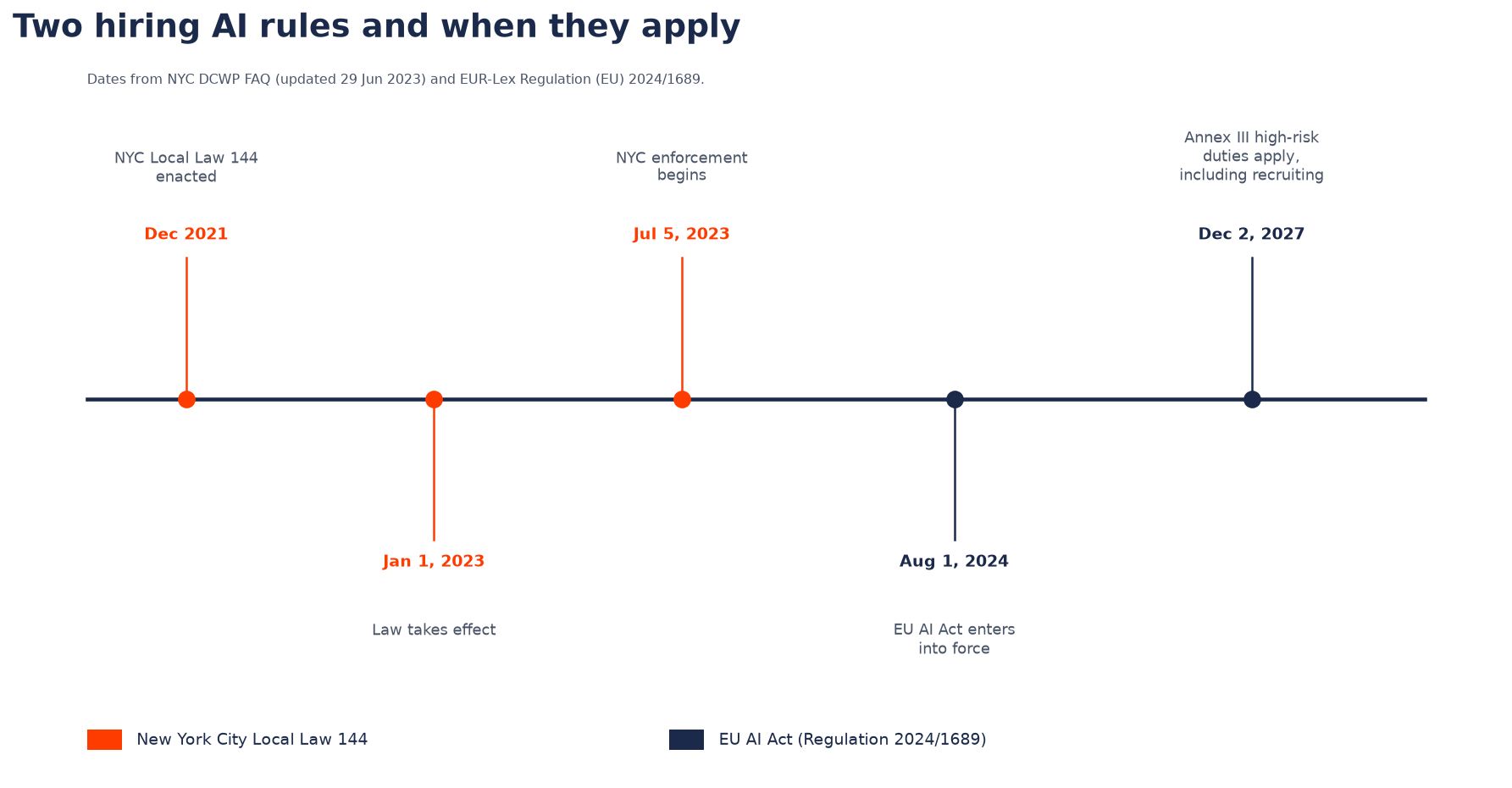
NYC Local Law 144 vs the EU AI Act
Comparison table 1: scroll horizontally or focus the table region and use the arrow keys to read every column.
| Topic | NYC Local Law 144 | EU AI Act (recruiting AI) |
|---|---|---|
| Official source | DCWP FAQ and Local Law 2021/144 | Regulation (EU) 2024/1689 |
| When it applies | Enforcement began 5 July 2023 | Annex III high-risk duties apply from 2 December 2027 |
| What is in scope | An AEDT used "in the city" to screen for hire or promotion | AI used to recruit, filter, or evaluate candidates |
| Core duties | Yearly independent bias audit, public summary, and notice | Risk management, documentation, transparency, and human oversight |
| Who is responsible | Employers and employment agencies, not the vendor, per DCWP | Providers and deployers, as the official text assigns |
A practical checklist for a small HR team
Use this with your counsel, not as a compliance program. Write down what the tool does and where the job and candidates are. Keep people in charge of every hiring decision. If an AEDT is in scope in New York City, plan for an independent bias audit, a public summary, and timely notice; do not assume the vendor has already done this. If you hire in the EU, put 2 December 2027 on your calendar. Keep a record of the setup and who approved each decision.
How ReadyATS approaches this
ReadyATS is AI hiring software for small and mid-size teams. Our AI Fairness page describes how scoring works. ReadyATS uses AI to read a resume into structured fields, suggest how well it matches the job's written requirements, and answer a recruiter's questions about their own applicants. It never makes a hiring decision. The 0 to 100 score is for one person and one job, with the evidence behind it. The scorer does not use name, photo, age, sex, ethnicity, or other listed protected traits. Maya never rejects someone because of an AI score.
An independent third-party bias audit has not yet been scheduled, and ReadyATS does not represent its scoring as independently bias-audited or certified. Employers remain responsible for the rules that apply to their jobs. If you are asking is AI hiring legal for your own workflow, start with that page and the official sources above.
No long-term commitment, cancel anytime.
Starting ReadyATS in 15 min Now
FAQ
Is AI hiring legal?
Often yes, but some places regulate tools that help assess or screen candidates. Local Law 144 already requires a bias audit and notice when an AEDT is used in New York City. The EU AI Act treats recruiting AI as high-risk, with those duties applying from 2 December 2027. This is not legal advice. Check the rules where the job is located.
What is an automated employment decision tool under Local Law 144?
DCWP says an AEDT is a computer-based tool that uses machine learning, statistical modeling, data analytics, or artificial intelligence, helps make employment decisions, and substantially assists or replaces discretionary decision-making. Whether a specific tool meets that test depends on how it is used.
Who has to get the bias audit done?
DCWP says employers and employment agencies are responsible for ensuring a bias audit was done before they use an AEDT. The vendor that created the tool is not responsible for that audit.
Does ReadyATS make the hiring decision?
No. Per the AI Fairness page, ReadyATS never makes a hiring decision. Scores support a recruiter's review, and Maya never rejects someone because of an AI score.