Small Business Hiring When Confidence Hits a Record Low
Small and midsize business sentiment hit a record low of 5.28 out of 10, yet 48 percent of employers added staff. Six steps to hire carefully without hiring slowly.
By ReadyATS Team · · 5 min read

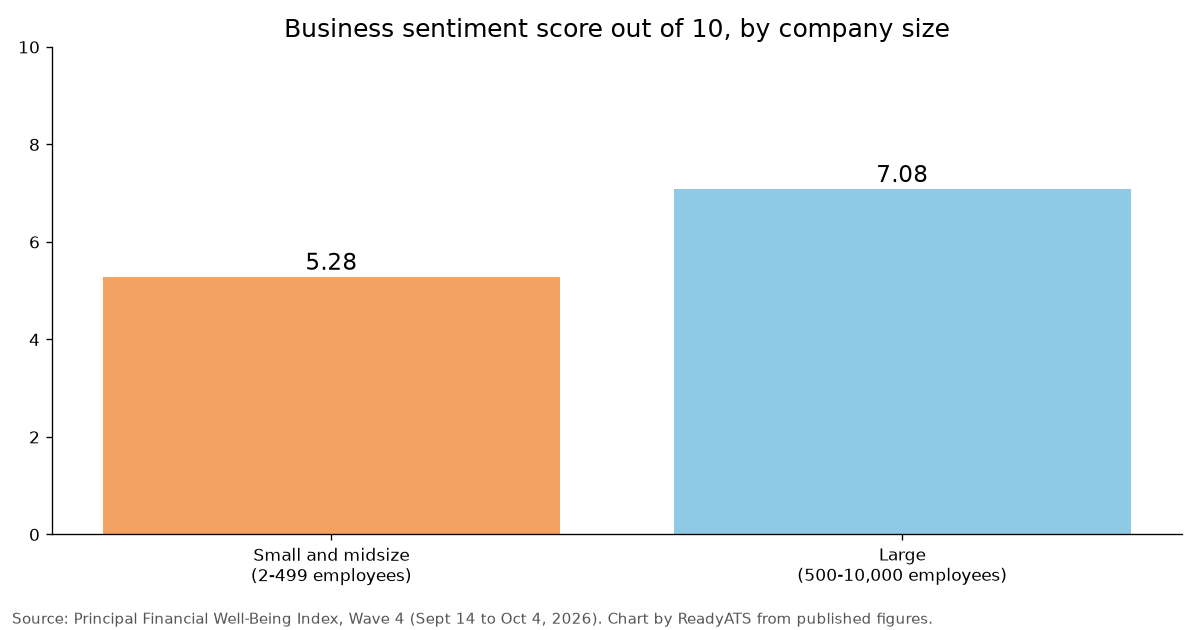
Small business owners are worried, and they are still hiring. On November 11, 2026, Principal Financial Group reported that sentiment among small and midsize businesses fell to 5.28 out of 10, a record low for its Financial Well-Being Index. Large businesses held nearly steady at 7.08, the widest gap between the two groups since March 2021 (Principal Financial Well-Being Index, November 11, 2026).
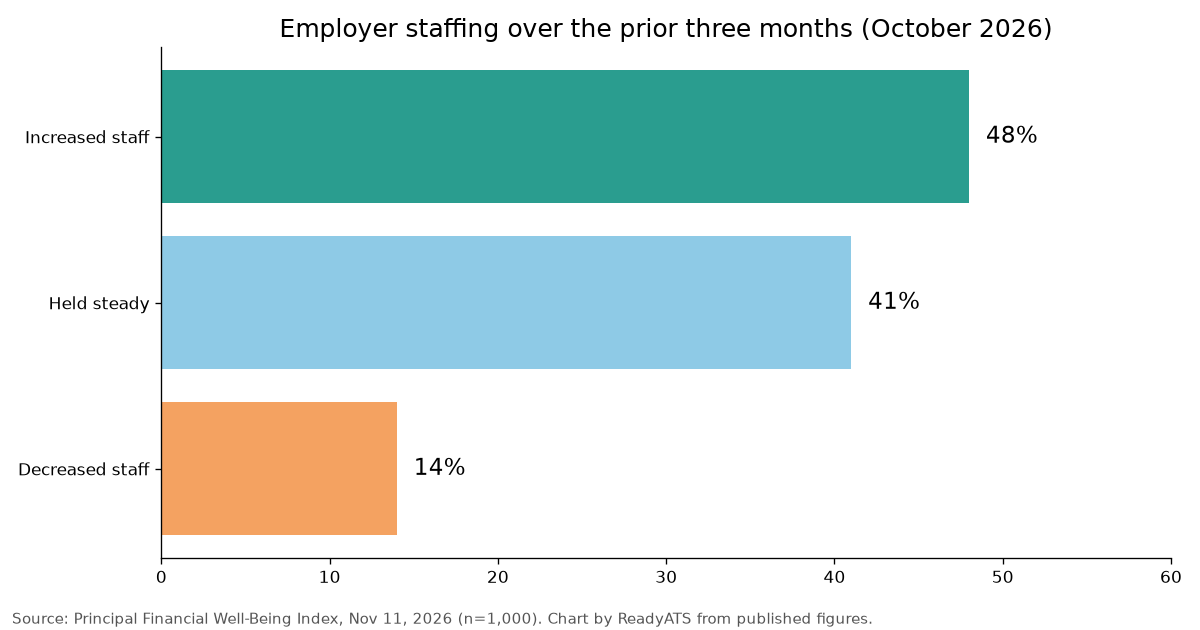
Why now: in the same survey, 48 percent of employers said they increased staffing over the prior three months. Hiring has not stopped. It has become more careful. If you run a restaurant, a garden center, a dental office, or a small contractor, each hire you make this winter carries more weight than it did a year ago. This guide covers how to hire well when the budget is tight and the outlook is cloudy.
What the survey found
Principal surveyed 1,000 business owners and leaders at companies with 2 to 10,000 employees between September 14 and October 4, 2026. For its comparison, small and midsize means 2 to 499 employees. A few findings matter for small employers:
- Overall business sentiment fell 8 percent from July to 6.02 out of 10, tying the lowest score since the Index began in 2021.
- Just 16 percent of leaders describe the U.S. economy as growing, yet 52 percent say their own business is growing.
- In October, 48 percent of employers increased staffing over the prior three months, 41 percent held steady, and 14 percent cut.
- Among the 89 percent of employers that changed how they operate in 2026, 93 percent cross-trained, upskilled, or moved existing employees into new roles, 72 percent brought in flexible or specialized talent, and 58 percent used AI and automation.
- Only 3 percent of employers reduced or eliminated a benefit in 2026.
Amy Friedrich, president of Benefits and Protection at Principal, explained why employers are holding on: "Many remember how hard it was to rebuild their teams after the last economic downturn, and they don't want to repeat that experience."
What it means for small employers
Low confidence plus steady hiring adds up to one rule: you cannot afford a wasted hire. A bad fit costs you training hours, overtime for the people covering, and a second round of hiring. A slow process costs you the good applicant, who takes another offer while you are still reading resumes.
The survey also shows where employers are putting their effort. Most are getting more from the people they already have, and many are adding flexible help. So the open roles that remain tend to be the ones that truly need a new person.
How to hire carefully without hiring slowly
1. Confirm the role needs a new hire
Before you post, ask whether cross-training or shifting hours covers the gap. If it does not, write down the two or three tasks this person must handle in the first month. That list becomes your job post and your interview questions.
2. Lead the post with what applicants check first
Put pay, schedule, and location at the top. Keep requirements to what the job truly needs. Hourly applicants often decide in seconds.
3. Reply within a day
Strong applicants rarely wait. A same day acknowledgment and a quick invite to interview keep them in your process instead of a competitor's.
4. Interview by video first
A 15 minute video call lets you meet more people without losing half a shift to each one. Bring finalists in for a working interview or a shop walk.
5. Screen every finalist the same way
Use the same questions, the same scorecard, and the same background check for every finalist. Consistency is fairer to candidates and makes your decision easier to explain.
6. Track time to hire
Note the date each role opened and the date the offer was accepted. If one role keeps taking twice as long as the rest, look at the post or the pay before you blame the market.
A hypothetical example
A hypothetical garden supply shop with nine employees loses a weekend cashier in November. The owner first checks whether a part-time stocker wants more hours. She does not, so the owner posts the role with pay and weekend hours in the first line, replies to every applicant the same day, and holds 15 minute video interviews on Tuesday. By Friday, two finalists have completed the same background check, and the owner makes an offer before the holiday rush.
Why ReadyATS
Careful hiring needs a system that keeps up with you. ReadyATS keeps posts, applicants, interviews, and checks in one place, and Maya, the recruiter assistant in ReadyATS, does the follow-through:
- A morning briefing that shows where hiring stalls. Maya puts the day's interviews, people waiting on a reply, and key numbers such as time to hire against a target on one short page.
- No strong applicant left waiting. Maya flags a high scoring applicant nobody has reviewed and lines up a self-schedule interview invite by email and text. You approve before it sends.
- Interview reminders handled. Maya sends reminders by email and text with a one tap reschedule link, so fewer candidates miss the call.
- Live interviews without the commute. Schedule interviews with Google Meet or Zoom links.
- Checkr background checks and Checkr Identity Verification through one integration, so every finalist goes through the same steps.
No long-term commitment, cancel anytime.
When every hire counts, make every step count too.
Starting ReadyATS in 15 min Now
FAQ
Are small businesses still hiring in late 2026?
Yes. In the Principal Financial Well-Being Index released November 11, 2026, 48 percent of employers said they increased staffing over the prior three months, even as small and midsize business sentiment hit a record low of 5.28 out of 10.
How can a small business hire on a tight budget?
Confirm the role needs a new person, lead the job post with pay and schedule, reply within a day, interview by video first, and screen every finalist the same way so you avoid a costly second search.
What counts as a small or midsize business in the Principal survey?
Principal defines small and midsize businesses as companies with 2 to 499 employees and large businesses as 500 to 10,000 employees.
How fast should a small business respond to applicants?
Aim for the same day. Strong hourly applicants often accept the first solid offer, so a quick acknowledgment and interview invite keep them in your process.