AI recruiting software vs applicant tracking system
AI recruiting software vs applicant tracking system: one holds the hiring record, the other helps with screening and follow-up. Many teams need both.
By ReadyATS Team · · 5 min read

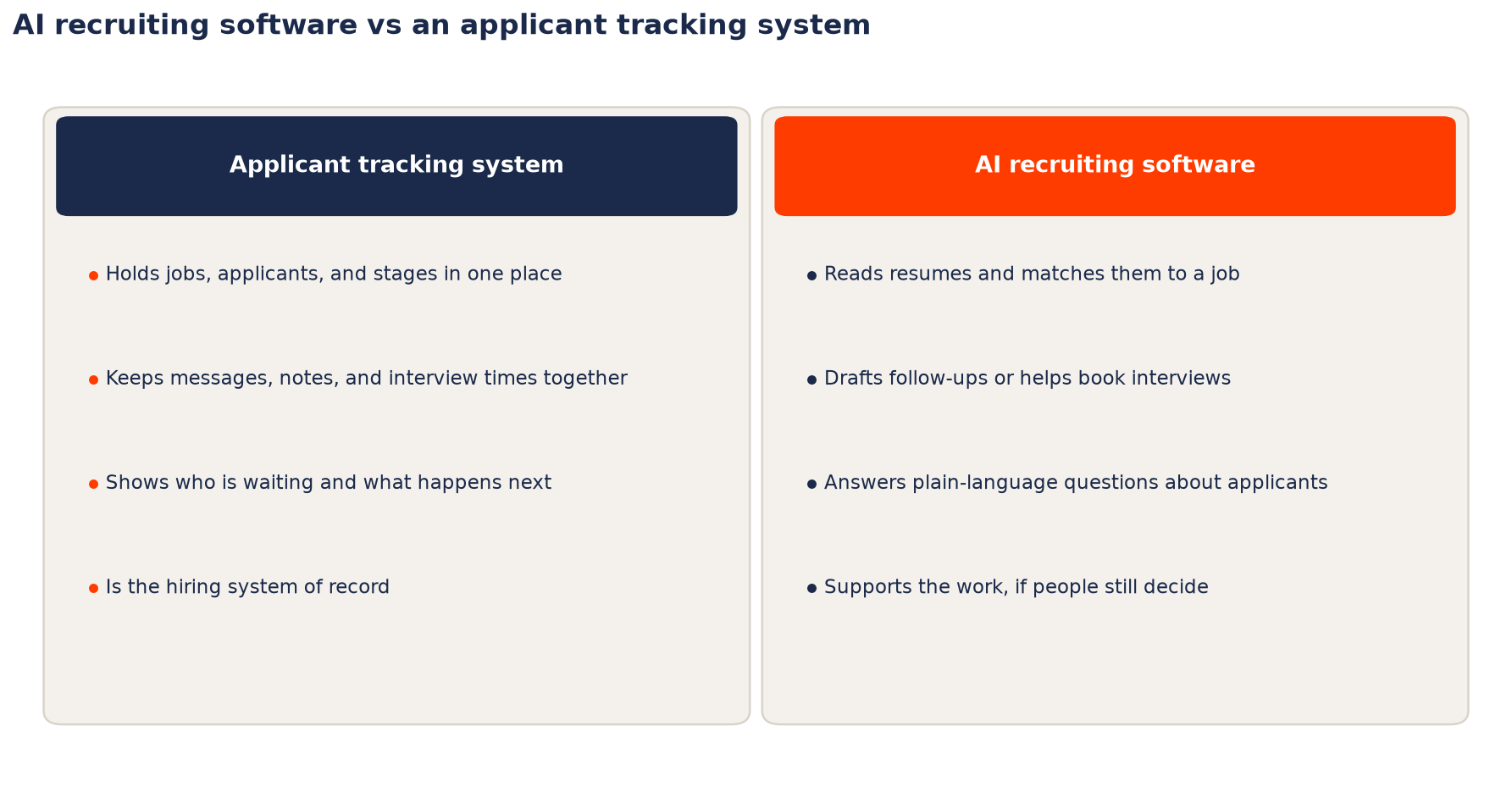
The search "AI recruiting software vs applicant tracking system" sounds like a choice between two products. It is usually a choice between two jobs the software should do. An applicant tracking system, or ATS, is the system of record for jobs, applicants, stages, notes, and interviews. AI recruiting software uses AI to help with work such as reading resumes, drafting follow-ups, answering candidate questions, or booking interviews. Some platforms do only one of those jobs. Others, including AI hiring software such as ReadyATS, put both in the same place so a small team does not keep a list in one tool and a score in another.
If the two are split, you will spend time copying names, statuses, and messages between systems. If they are combined, you still need to be clear which part is the record and which part is only a suggestion.
AI recruiting software vs applicant tracking system: what each one is for
An applicant tracking system holds the process. It is where you post the job, collect applications, move people from stage to stage, store messages and interview times, and see who is waiting. When a new opening appears, you should be able to look back at last year's applicants in the same system. Our applicant tracking systems explained guide and the current best ATS systems comparison cover that category in more depth.
AI recruiting software helps with the work inside that process. It may parse a resume, suggest how well a file matches a job, draft a text or email, offer interview times, or answer a plain-language question such as "who applied this week and has weekend availability?" Our best AI recruiting software guide is the place to compare tools. This post is about the difference, not a ranked list.
The useful test is not the label on the website. When you come in tomorrow, can you see every open job, every person in the pipeline, and the next step, in one place? And when the software offers a score or a drafted message, can you see why, and can a person still say no?
A task-by-task comparison
Comparison table 1: scroll horizontally or focus the table region and use the arrow keys to read every column.
| Hiring task | Applicant tracking system | AI recruiting software | What a small team needs |
|---|---|---|---|
| Post a job and collect applications | Core job | Sometimes included | One place for every application |
| Keep stages, notes, and interviews together | Core job | Weak if it is only a side tool | A shared record, not a second spreadsheet |
| Screen resumes against the job | Manual, or a basic filter | Core job, if it shows evidence | A suggestion you can check, not a hidden rank |
| Text or email candidates | Often built in, or attached | May draft the message | The thread should live on the candidate record |
| Book a Meet or Zoom interview | Calendar and links | May offer times or reminders | The interview must show up on the same record |
| Search past applicants | Keyword or filter search | Plain-language search over your own files | Search your records, not a rented people database |
| Make the hire or the rejection | A person updates the stage | Should never do this alone | A human decision, with a log |
A hypothetical example: a 40-person clinic needs two medical assistants and collects 80 applications in the ATS. An AI screen suggests 12 files that match the listed certification and hours, each with the resume evidence. The manager reads those 12, rejects no one on the score alone, and books video interviews from the same record. The AI helped with the first pass. The ATS kept the trail. She made the decision.
When you need both, and when one platform is enough
You need an ATS as soon as more than one person is hiring, or as soon as applications arrive in more than one inbox. A spreadsheet breaks down when a candidate is in email, a text thread, and a paper note at the same time.
You need AI recruiting help when the first pass, the follow-up, or the search is eating the week. Keep the same rule we describe for AI resume screening: show the evidence, and never let a score reject someone on its own.
One platform is enough when it is a real ATS and the AI sits inside it. ReadyATS is built that way. Basic is $199 a month ($179 billed yearly) for up to 10 active jobs, and Pro is $499 a month ($449 billed yearly) for up to 25, with $0 per-user fees, as listed on the AI hiring software page (checked 11 November 2026). Ask Maya and AI resume scoring with evidence are included. Interviews can be scheduled with Google Meet or Zoom. Pro adds recorded video interviews, onboarding with e-signatures, SMS campaigns, and Checkr background checks. SMS usage may cost extra.
What ReadyATS does not do: Maya never rejects someone because of an AI score. Every stage change, offer, and rejection is made by a person at the employer. See the AI Fairness page for what scoring uses and what it never uses.
If you are still sorting out AI recruiting software vs applicant tracking system options, start with the work you have to finish this month. Then pick a system that keeps that work and the applicant record together.
No long-term commitment, cancel anytime.
Starting ReadyATS in 15 min Now
FAQ
What is the difference in AI recruiting software vs applicant tracking system tools?
An applicant tracking system is the hiring system of record: jobs, applicants, stages, messages, and interviews. AI recruiting software uses AI to help with work such as screening, follow-up, search, or scheduling. Some products do one job. Some, including ReadyATS, do both in one place.
Can AI recruiting software replace an ATS?
Not if you still need a shared record of every applicant and every stage. AI can speed a first review or a follow-up, but the decision and the history should live in the ATS.
Does ReadyATS include both?
Yes. ReadyATS is an applicant tracking system with built-in AI hiring tools, including resume scoring with evidence and Ask Maya search over your own records. People make every hiring decision.
Is the AI optional?
In ReadyATS, recruiters can override, ignore, or turn off AI scoring per account, as described on the AI Fairness page. The applicant record still stays in the system.