AI resume screening: how it works and how to avoid bias
AI resume screening can speed a first review if it shows its evidence and a person still decides. Here is how it works and how to avoid bias.
By ReadyATS Team · · 5 min read

AI resume screening is software that reads an application and suggests how well that person matches a specific job, so a recruiter can start with a shorter list. Used carefully, it can save a small HR team from opening every file in arrival order. Used carelessly, it can hide good people or repeat old hiring patterns. This guide explains how it works, where bias can enter, and how to keep a person in charge of every decision. It pairs with our AI hiring software page and our AI Fairness page.
No screening tool is bias-free on its own. You should be able to see why a file was scored, confirm that only job-related evidence was used, and still review, override, or ignore the result.
How AI resume screening works
Most tools follow the same four steps.
- Read the resume into data. The file is parsed into fields such as titles, dates, skills, and locations, then stored so the same PDF is not sent through a model over and over.
- Compare that profile with the job. The tool looks at the requirements written in the job description, not a hidden idea of a "typical hire."
- Produce a suggestion, with evidence. The useful version shows the resume sentence that supports each match, and the points added or removed.
- A person decides. A recruiter reads the file, interviews the person, and makes every stage change, rejection, and offer.
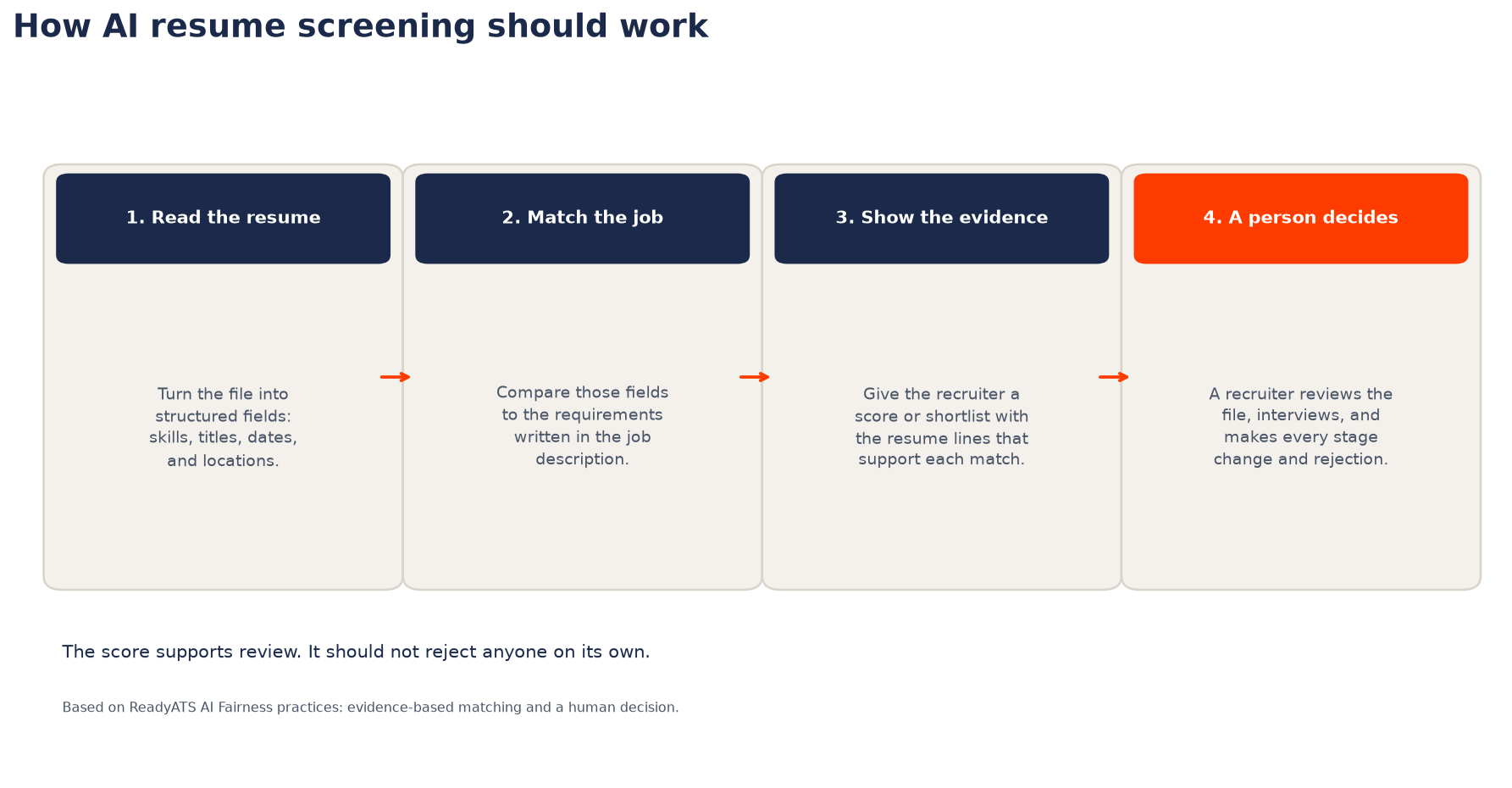
If you cannot see the evidence, you are not screening. You are trusting a number you cannot explain to a candidate, a hiring manager, or an auditor.
Where bias can enter
Bias does not require anyone to intend harm. It can appear in the data, in the job requirements, or in how the output is used.
- The tool uses signals that are not the job, such as name, photo, age, address, or school prestige, or it treats an employment gap as a defect the resume never stated.
- The tool learns from past hires and repeats a narrow pattern from last year's files.
- Scores are treated as rankings against other people, so a person's match rises or falls when someone else applies.
- A low score auto-rejects the file, with no human review. That is a hiring decision made by software, and some rules treat automated screening as a regulated employment decision. See is AI hiring legal.
- Knock-out rules are hidden or inferred, instead of written by the employer and shown on the application.
How to avoid bias in AI resume screening
These practices will not make any tool perfect. They do make the work reviewable.
Comparison table 1: scroll horizontally or focus the table region and use the arrow keys to read every column.
| Practice | Why it helps | What to look for |
|---|---|---|
| Score one person against one job | The result is about the role, not a contest with the rest of the pile | A per-job score or requirement list, not a reshuffled ranking of the whole pool |
| Show the evidence | A recruiter can check a match or a miss | The resume line, the requirement, and the points added or removed |
| Use only job-related inputs | Protected traits and proxies stay out of the score | A published list of what the tool does not use |
| Keep the score deterministic | The same resume and the same job get the same result | A vendor that will say this plainly and test it |
| Let people override or turn it off | The tool supports review, it does not replace it | Per-account controls, and no auto-reject on an AI score |
| Write knock-out questions yourself | The candidate sees the rule and can answer it | Employer-authored questions, not inferred filters |
A simple weekly habit helps: read a sample of high, mid, and low scores yourself. If a strong file is at the bottom, or a weak file is at the top with thin evidence, fix the job requirements or change how you use the tool.
What ReadyATS does, and what it does not do
ReadyATS includes AI resume screening as part of its AI hiring software. The details below come from the live AI Fairness page.
- The score is a number from 0 to 100 for one candidate and one job, built from the job's own requirement list and the evidence found in the resume.
- Each score comes with the requirement list, which items matched, the resume sentence that supports each match, and the points added or removed.
- It is deterministic: the same resume and the same job produce the same score. ReadyATS says this was verified on real applicants (15 of 15 repeated runs identical) and is part of release tests. A requirement counts only when the resume states it. The score does not guess from the school's name, the company's reputation, or gaps in employment.
- The scorer does not use name, photo, age, date of birth, gender, ethnicity, disability, veteran status, nationality, marital status, religion, home address, social media, credit, criminal, or health data. Scores are not relative rankings and do not change when other people apply.
- Scores are suggestions. Recruiters can override, ignore, or turn off AI scoring. ReadyATS never makes a hiring decision. Maya never rejects someone because of an AI score.
- An independent third-party bias audit has not yet been scheduled. ReadyATS does not represent its automated scoring as independently bias-audited or certified.
Ask Maya works over your own parsed profiles. You can ask for people with a skill or location, then edit the filters before you contact anyone.
No long-term commitment, cancel anytime.
Starting ReadyATS in 15 min Now
FAQ
What is AI resume screening?
AI resume screening is software that reads a resume, compares it with a job's stated requirements, and suggests a match, a score, or a shortlist so a recruiter can review the file. The hiring decision should stay with a person.
Can AI resume screening be used without bias?
No tool is bias-free on its own. Risk falls when the score is based on job-related evidence, protected traits are kept out, the same file gets the same result, a person can override it, and the tool never rejects someone on an AI score alone.
Should a low score auto-reject a candidate?
No. In ReadyATS, scores support review, and Maya never rejects someone because of an AI score. Automatic knock-outs, if you use them, should be rules you wrote and showed to the applicant, such as a required license.
How is this different from a keyword search?
A keyword search looks for a word. Evidence-based screening looks for a stated requirement and shows the resume line that supports the match, so you can judge whether the evidence is real.