Rejection Email Template: 8 Examples for Every Stage
Eight copy-paste rejection emails for every hiring stage, a what-not-to-say checklist, and a timing guide.
By ReadyATS Team · · 5 min read

In brief: A good rejection email template thanks the candidate by name, states the decision in the first two sentences, offers one next step and closes warmly. Send it promptly, keep any reason job-related, and call instead of emailing after a final round.
A good rejection email template tells candidates the decision quickly, kindly and with less legal risk. Below are eight copy-paste rejection emails for each hiring stage, from "thanks for applying" to "after the final interview," plus a checklist of what not to say and how to automate the early ones. ReadyATS wrote every template for this guide. This is general guidance, not legal advice.
How do you write a job rejection email?
Use five parts: thank them by name, state the decision in the first two sentences, give a brief job-related reason only if your policy allows, offer one next step such as your talent pool, and close warmly. Short and clear is kinder than long and vague.
8 rejection email template examples by stage
Replace the brackets. Subject line for all: "Your application for [Role] at [Company]".
1. Application, not shortlisted
Hi [Name], thank you for applying for the [Role] position. We reviewed your application and have decided not to move forward with it for this role. We appreciate your interest in [Company] and wish you the best in your search. [Your name]
2. After a phone screen
Hi [Name], thank you for speaking with me about the [Role] role. After comparing candidates, we are moving ahead with others whose experience more closely matches what this role needs right now. I enjoyed hearing about [specific detail]. Best of luck, [Your name]
3. After an interview
Hi [Name], thank you for interviewing for [Role] and for the time you gave our team. We have decided not to move forward. If you would like brief feedback, reply to this email and I will share what I can. [Your name]
4. After the final round
Hi [Name], thank you for going through every stage with us. We have offered the [Role] position to another candidate. The team valued [specific strength], and I would like to stay in touch for future roles if you are open to it. [Your name]
5. Internal candidate
Hi [Name], thank you for applying for [Role]. We have chosen another candidate, and I wanted you to hear it from me first. Can we set up 20 minutes to talk about what's next for you here? [Your name]
6. Talent pool
Hi [Name], we have filled the [Role] position, but you stood out. With your permission, we will keep your profile on file and reach out when a fitting role opens. Reply "yes" to stay in our talent pool. [Your name]
7. No-show
Hi [Name], we missed you at our [date] interview for [Role], so we have closed this step for now. If something came up, reply within [X] days and we will see what is possible. [Your name]
8. Offer withdrawn (role closed)
Hi [Name], I am sorry to share that the [Role] position has been closed because of [brief business reason], so we are withdrawing our offer. I know this is disappointing, and I am happy to talk by phone today. [Your name]
Phone or email?
Email works for early stages: applications and phone screens. After a final interview, a short call followed by an email is kinder. For internal candidates and withdrawn offers, call or meet first.
What not to say: a checklist for less legal risk
Federal law bars employment decisions based on race, color, religion, sex (including transgender status, sexual orientation and pregnancy), national origin, age (40 or older), disability or genetic information (EEOC). In a rejection email, don't mention:
- Any of those characteristics, even in passing.
- "Culture fit" with no job-related explanation.
- Reasons you can't back up, such as "overqualified."
- Promises like "we'll definitely call you for the next role."
When in doubt, say less and keep it job-related. Your state may add protections, so check with counsel for your situation.
Rejection email timing by stage
Comparison table 1: scroll horizontally or focus the table region and use the arrow keys to read every column.
| Stage | Send within | Personal touch | Offer feedback? | Template |
|---|---|---|---|---|
| Application | 5 business days | Low (name, role) | No | 1 |
| After phone screen | 3 business days | Medium | Optional | 2 |
| After interview or final | 2 business days; consider a call | High | If policy allows | 3, 4 |
| Internal candidate | Same day, in person first | High | Yes | 5 |
| Talent pool | With the final decision | High | If policy allows | 6 |
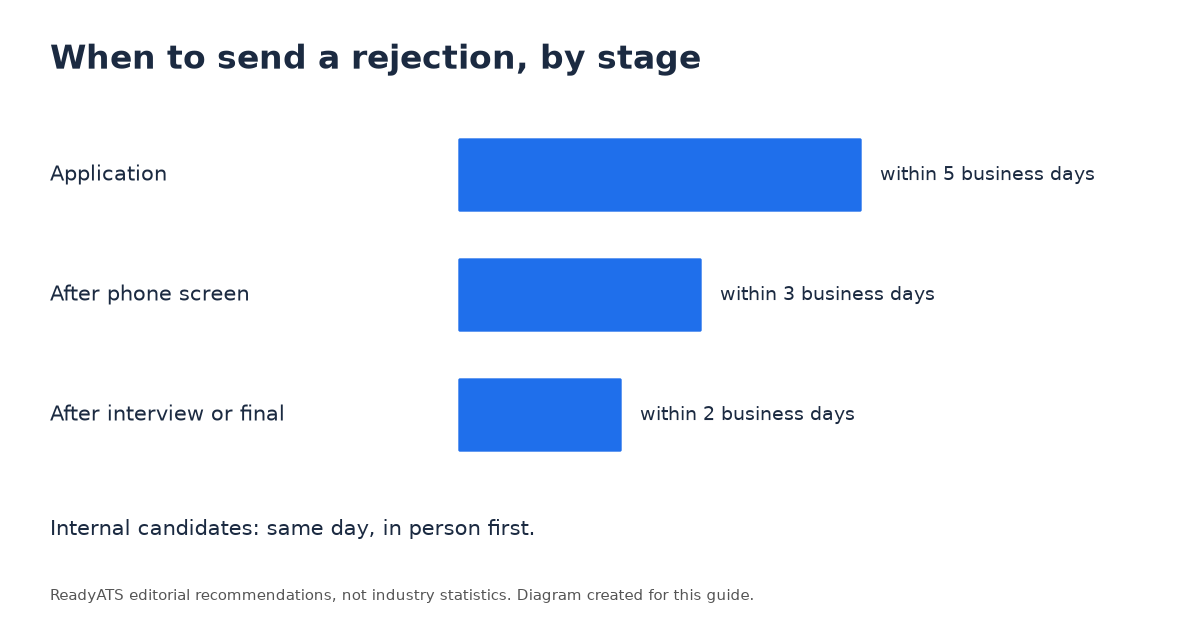
These timings are ReadyATS editorial recommendations, not industry statistics.
Automate the early ones without sounding robotic
Automate templates 1 and 2, and personalize 3 to 8. ReadyATS includes automated email responses on every plan and keeps silver medalists in talent pools you can search and re-engage later (pricing). Maya never rejects anyone because of an AI score, and candidates are never told a score or a pass or fail result (AI Fairness). Related reading: hiring process steps and free job boards for employers.
Why ReadyATS
Basic is $199 a month, or $179 a month billed yearly, with unlimited users at $0 per user, AI resume scoring with evidence, Google Meet and Zoom interview links, 1:1 texting and automated email responses (pricing, checked Nov. 11, 2026). Pro adds Checkr background checks from the candidate page. Checkr Identity Verification is available through the same Checkr integration, as confirmed by the ReadyATS team on Oct. 23, 2026. ReadyATS does not handle Form I-9 or work-authorization checks. No long-term commitment, cancel anytime.
FAQ
What should a rejection email template include?
The candidate's name, the role, a clear decision in the first two sentences, an optional job-related reason, one next step and a warm close.
Should I send rejection emails to every applicant?
Yes. Every applicant deserves an answer, and an ATS can send the early-stage ones automatically.
Should you give a reason for rejection?
Keep any reason brief and job-related, and never mention protected characteristics.
Is it better to reject by phone or email?
Email works for early stages. A call is kinder after final interviews and for internal candidates.
Answer every candidate without the busywork
Send the early replies automatically and save your time for the conversations that matter.
Starting ReadyATS in 15 min Now
No long-term commitment, cancel anytime.