Hiring Process Steps: A 10-Step Guide for Small Businesses
A 10-step hiring process for small businesses without a recruiter, with a check for each step and the stage where most teams lose candidates.
By ReadyATS Team · · 5 min read

In brief: The hiring process steps for a small business are: define the role, write the job description, post it, screen, phone screen, interview, check references, decide, send the offer and rejections, and onboard. Give each step one owner and a deadline, and fix speed to interview first.
These hiring process steps take a small business from "we need someone" to a signed offer and a smooth first day. Below is a 10-step process built for teams without a recruiter, with a quick check for each step, the stage where most small teams lose candidates, and a printable checklist. If you are hiring right now, pair it with our guide on how to hire employees for a small business.
What are the stages of a hiring process?
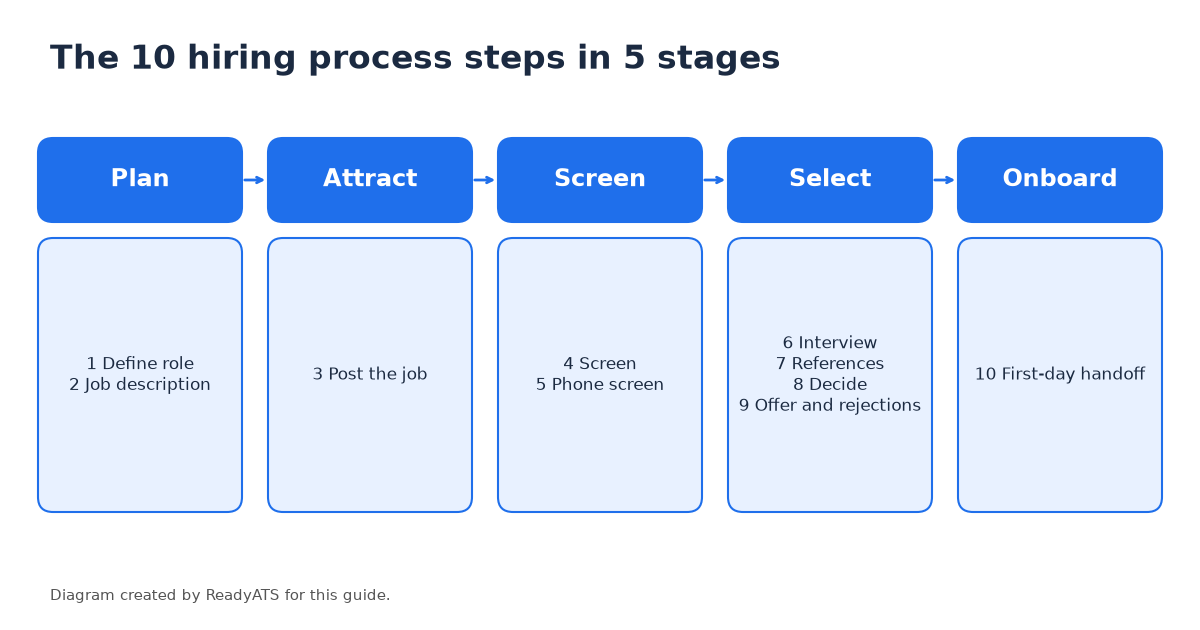
Most hiring follows five stages: plan the role, attract candidates, screen them, select the best fit, and onboard. Inside those stages sit ten concrete steps, from writing the job description to the first-day handoff. Small teams do best when each step has one owner and a deadline.
The 10 hiring process steps for small businesses
- Define the role. Write the outcomes you need in the first 90 days, the must-have skills and the pay range. Check: is the budget approved?
- Write the job description. Lead with pay, location and schedule, in plain language. Check: could a candidate tell what a normal week looks like?
- Post the job. Start with free job boards for employers, then add paid reach only where you need it. Check: is it posted where your candidates actually look?
- Screen applicants. Compare each application with the must-haves from step 1, and nothing else. Check: was every applicant reviewed within two business days?
- Phone screen. Spend 15 minutes on pay, schedule and motivation. Text candidates who go quiet on email (text recruiting tools). Check: was the call booked within 48 hours?
- Interview. Ask every candidate the same questions and score answers right after. Check: is the scorecard filled in?
- References and checks. Call two references. Before you order a background report from a screening company, the FCRA requires a stand-alone written notice and the candidate's written permission (EEOC and FTC guidance). Check: is permission on file?
- Decide. Meet once, compare scores and choose. Check: was the decision made within a day of the last interview?
- Offer and rejections. Call your pick, then send the offer in writing. Tell everyone else, kindly (rejection email template). Check: did every candidate get an answer?
- Onboard. Send paperwork, a first-day schedule and a buddy's name before day one. Check: are logins, equipment and the schedule ready?
What are the 5 steps in the hiring process?
A condensed version groups the ten: plan (steps 1 and 2), attract (step 3), screen (steps 4 and 5), select (steps 6 to 9) and onboard (step 10). It is the same process at a higher level, which makes it easier to assign owners.
What are the 7 steps of the recruitment process?
Recruitment is the front half of hiring. A common seven-step view: identify the need, write the description, source, screen, interview, select and offer. Hiring adds the decision paperwork and onboarding. Put simply, recruitment fills the pipeline and hiring closes it.
Hiring process steps compared: manual vs ATS
Comparison table 1: scroll horizontally or focus the table region and use the arrow keys to read every column.
| Step | Manual (spreadsheet and email) | With an ATS | Owner |
|---|---|---|---|
| 1. Define the role | Doc | Job template | Hiring manager |
| 2. Job description | Doc | Saved template | Hiring manager |
| 3. Post | Each board by hand | Publish once to connected boards | Admin |
| 4. Screen | Read every resume in arrival order | AI resume scoring with evidence, reviewed by a person | Hiring manager |
| 5. Phone screen | Email back and forth | Scheduling links and texts | Hiring manager |
| 6. Interview | Calendar juggling | Google Meet or Zoom links, scorecards | Panel |
| 7. References and checks | Manual | Tracked task, background check from the candidate page | Admin |
| 8. Decision | Group chat | Shared pipeline | Hiring manager |
| 9. Offer and rejections | Ad hoc | Templates and automated emails | Hiring manager |
| 10. Onboarding | Paper checklist | Onboarding documents and e-signatures | Admin |
Where small teams lose candidates
Our view: steps 4 to 6. The application sits unread for a week, the phone screen takes five emails to book, and by then the candidate has taken another offer. Fix speed to interview first. Every other improvement matters less if strong people drop out before you meet them. AI hiring software can help here by sorting the pile and booking the call, as long as a person still makes the decision.
Printable hiring checklist
- [ ] Role outcomes, skills and pay range written
- [ ] Job description with pay, location and schedule
- [ ] Posted to at least two free boards
- [ ] Applicants screened within two business days
- [ ] Phone screens booked within 48 hours
- [ ] Same interview questions and scorecard for everyone
- [ ] References called; written permission on file for any background report
- [ ] Decision made within a day of the final interview
- [ ] Offer sent; every other candidate answered
- [ ] Day-one schedule, accounts and buddy ready
Why ReadyATS
ReadyATS is built for small teams that want to reach the interview faster. Basic is $199 a month, or $179 a month billed yearly, with up to 10 active jobs, unlimited users at $0 per user, AI resume scoring with evidence, Google Meet and Zoom interview links, and 1:1 texting (pricing, checked Nov. 11, 2026). Pro adds Checkr background checks from the candidate page and onboarding with e-signatures (pricing). Checkr Identity Verification is available through the same Checkr integration, as confirmed by the ReadyATS team on Oct. 23, 2026. ReadyATS does not handle Form I-9 or work-authorization checks. No long-term commitment, cancel anytime.
FAQ
What are the hiring process steps?
Define the role, write the job description, post it, screen applicants, phone screen, interview, check references, decide, send the offer and rejections, and onboard.
How long should the hiring process take?
It varies by role and market. Track your own time from posting to accepted offer, and work hardest on the gap between application and first interview.
What are the 5 steps in the hiring process?
Plan, attract, screen, select and onboard. It is a condensed version of the ten hiring process steps.
What is the difference between recruitment and hiring?
Recruitment attracts and screens candidates. Hiring covers selection through the offer and onboarding.
How can a small business speed up hiring?
Screen applicants within two business days, book phone screens within 48 hours, and let candidates pick their own interview time.
Turn these steps into a hiring routine this week
Post once, screen faster and book interviews without the email back and forth.
Starting ReadyATS in 15 min Now
No long-term commitment, cancel anytime.