AI in Hiring Survey: Where AI Helps and a Person Decides
UK hiring managers use AI most for CV screening, skills matching and job ads. For US hourly employers, the clearest wins are the repetitive tasks, while the hiring decision stays with a person.
By ReadyATS Team · · 5 min read

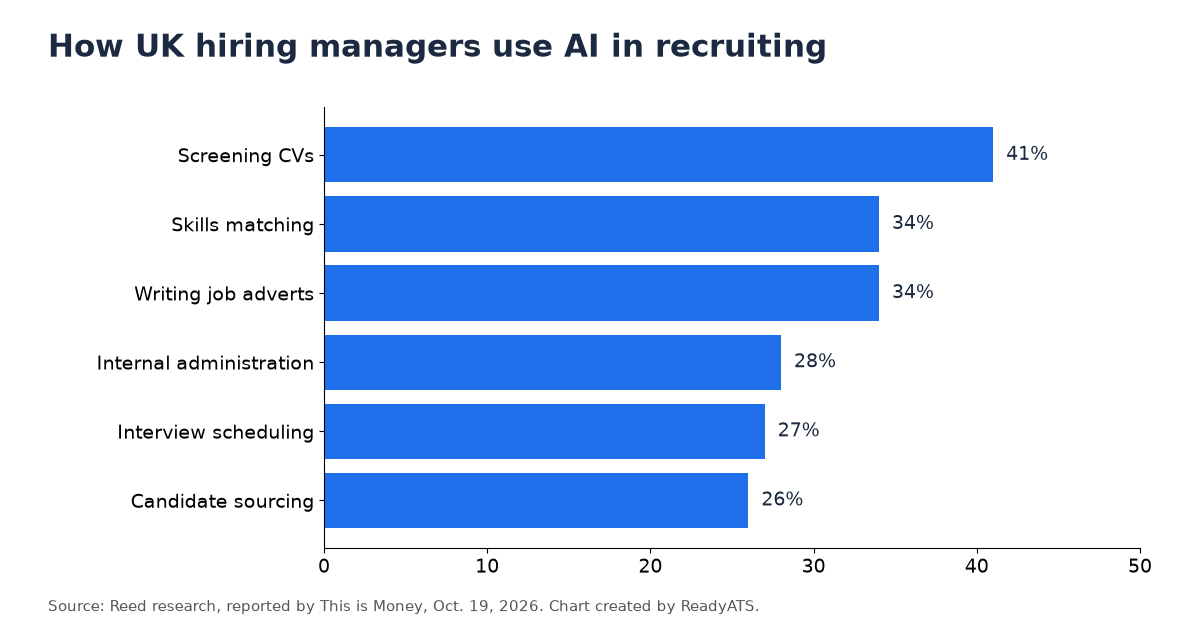
In brief: A Reed survey of UK hiring managers found AI is used most for screening CVs (41%), skills matching and job adverts (34% each) and interview scheduling (27%). For US hourly employers, automate the busywork around the decision and keep a person on the decision itself.
More than half of UK hiring managers think AI is shrinking job opportunities, and most of their organisations already use it to hire. That is the headline from a new AI in hiring survey by UK recruitment firm Reed, reported by This is Money on Oct. 19, 2026.
This is UK data, not US data. But the list of where hiring managers actually use AI is useful for any small employer deciding what to hand to software and what to keep.
What the AI in hiring survey found
According to This is Money, Reed found that:
- 52% of hiring managers say AI is leading to fewer job opportunities in the UK.
- 36% say it is already contributing to lower recruitment in their own organisation.
- 17%, about one in six, said their organisation was not using AI in recruitment.
The most common uses of AI in recruiting were:
Comparison table 1: scroll horizontally or focus the table region and use the arrow keys to read every column.
| Use of AI in recruiting | Share of UK hiring managers | Risk if it goes wrong |
|---|---|---|
| Screening CVs | 41% | High: a good candidate may never get a look |
| Skills matching | 34% | High: depends on what the criteria leave out |
| Writing job adverts | 34% | Low: easy to read and fix before posting |
| Internal administration | 28% | Low |
| Interview scheduling | 27% | Low: a wrong slot is quick to spot |
| Candidate sourcing | 26% | Medium |
Shares are from Reed via This is Money. The risk column is our own editorial view. The article does not give the sample size or survey dates, so treat the figures as a snapshot of UK hiring managers, not a measure of US employers.
What US hourly employers can take from it
The list splits into two kinds of work. The first is repetitive and low risk: writing a job ad, booking an interview, handling admin. A mistake there costs a few minutes and is easy to spot. The second is judgment: deciding who is a fit and who moves forward. A mistake there costs you a good worker, and the candidate may never know why.
Screening CVs topped the UK list. For hourly roles, that is where a person matters most, because the details that predict a good hire often aren't on paper.
The case for automating the busywork
Picture a hypothetical manager at a regional cleaning company with a stack of applications for an evening crew. She does not need software to tell her who to hire. She needs her afternoon back.
Writing the job ad, sending each applicant a quick text and finding interview slots around her own shifts can eat a full day. That is where automation earns its place. In ReadyATS, Maya can send interview reminders by email and text and propose self-scheduling invites for strong applicants that nobody has looked at yet, with the level of automation set by your team (features). The faster those steps happen, the sooner she is talking to real people.
Why a person should make the hiring call
Now picture an applicant near the bottom of her list on paper: a two-year gap, a short resume, a home four minutes away. He has done this work before, informally, for family, and he can start Monday. A keyword filter may never surface him. A person who reads the application, or makes a two-minute call, will.
That is the line worth drawing. Let software speed up the steps around the decision, and keep a human on the decision itself. Our guide to AI resume screening explains how to keep scoring fair.
Questions to ask before you add AI to hiring
- Which tasks are we automating: ads, scheduling, reminders or screening?
- If a tool scores applicants, can a person see everyone and override the result?
- Who makes the final call, and is that written down?
- Can we explain to a candidate why they did or did not move forward?
Where ReadyATS fits
ReadyATS is AI hiring software for small and mid-size teams. Basic is $199 a month, or $179 a month billed yearly, with unlimited users at $0 per user, AI resume scoring with evidence, Google Meet and Zoom interview links, 1:1 texting and Ask Maya (pricing). Maya never rejects anyone because of an AI score; every stage change, offer and rejection is made by a person at the employer (AI Fairness). Pro adds Checkr background checks from the candidate page, and Checkr Identity Verification is available through the same integration, as confirmed by the ReadyATS team on Oct. 23, 2026. ReadyATS does not handle Form I-9 or work-authorization checks. No long-term commitment, cancel anytime.
FAQ
What did the Reed AI in hiring survey find?
52% of UK hiring managers said AI is leading to fewer job opportunities, and 36% said it already contributes to lower recruitment at their organisation. Only 17% said their organisation was not using AI in recruitment.
What do UK hiring managers use AI for most?
Screening CVs (41%), skills matching and writing job adverts (34% each), internal administration (28%), interview scheduling (27%) and candidate sourcing (26%).
Where does AI help most in hourly hiring?
In repetitive steps such as writing job ads, contacting applicants and scheduling interviews, where speed matters and mistakes are easy to catch.
Does ReadyATS decide who gets hired?
No. Maya never rejects anyone because of an AI score. Your team decides who moves forward and who gets hired.
Get your afternoon back, and keep the hiring call yours
Let software handle the busywork while your team makes every hiring decision.
Starting ReadyATS in 15 min Now
No long-term commitment, cancel anytime.